Reading
Your place is saved on this device as you read.
Based on reported paranormal-investigation accounts. Some events, characters, and identifying details have been fictionalized.
1. Arrival
By the time Eli turned the camera on, rain had sheeted across the Kestrel’s front drive hard enough to turn the headlights of arriving cars into white smears on the pavement. He stood under the porte cochere with his jacket dark at the shoulders and framed the hotel beyond a baggage cart stacked with hard-shell suitcases. Warm windows rose four floors above him. A shuttle idled at the curb while two children in matching raincoats chased each other around their mother’s legs and a bellman tried to keep a garment bag from dragging through a puddle.
Eli checked the red recording icon, lifted the camera a little, and put on the voice that came easiest once a lens was pointed at him.
“Made it to the Kestrel. We’ve got the room for the night, ghost tour in about forty minutes, and after that we’re going to see how long my dad lasts before he decides this was a terrible idea.”
Martin’s voice came from behind him. “I decided that in the car.”
Eli swung the camera around.
His father stood beside the open trunk with a tripod case in one hand and Eli’s equipment bag in the other. Rain blew under the roof and dotted his glasses. He looked into the lens with the patient expression of someone being made to pose for a photograph he had not requested.
“You drove six hours,” Eli said.
“I was promised dinner.”
“That’s your statement?”
“That’s my statement until dinner.”
Eli laughed and lowered the camera. Martin handed him the equipment bag but kept the tripod, then nodded toward the lobby doors.
“Come on. You can make it ominous after we’re dry.”
Inside, the Kestrel was busy enough that Eli had to step aside almost immediately for a family rolling three suitcases toward the elevators. Wet coats gave the lobby a faint wool smell. A conference group occupied the couches beneath a row of old landscape photographs, their plastic name badges turned backward or tucked into shirt pockets now that the day’s sessions were over. Somewhere past the front desk, dishes knocked together in a dining room. The elevator chimed, opened, filled, and shut again. A ceiling vent moved a steady ribbon of warm air across the registration counter.
Eli filmed some of it anyway: the brass mail slots that had survived whatever renovations had put key-card readers on the doors, the worn stair rail, the rain tracking down the tall windows. Nothing about the lobby suggested an investigation site. People were asking for extra towels and directions to the bar.
At check-in, the clerk gave them two key cards and pointed out the elevators, breakfast hours, and the meeting place for the evening tour. Martin listened to all of it. Eli watched the clock over the desk.
“Forty minutes,” he said when they had their bags again.
“Thirty-seven now.”
“You’re getting into it.”
“I’m getting hungry.”
The elevator carried them up with an older couple and a woman holding a sleeping toddler against her shoulder. Eli kept the camera down. The little boy’s sneaker bumped softly against the woman’s coat each time the car slowed. On the upper floor, the doors opened onto a carpeted corridor where a housekeeping cart had been parked in an alcove. A vacuum cleaner sat unplugged beside it. Farther down, somebody laughed behind a closed door.
Martin glanced along the hall. “Terrifying.”
“Save some material for the interview.”
“I have notes.”
Their room was near the end of the corridor. Eli unlocked it and entered first with the camera running again.
The room had been updated without losing all of its older proportions. Two chairs sat near the window with a small round table between them. A dark wooden dresser faced the bed. The bathroom occupied a narrow recess near the entrance, its door opening inward toward a tiled floor. Warm air came through a vent below the window with a low mechanical hiss. Rain tapped against the glass, quieter here than it had been downstairs.
Eli panned slowly across the room, then caught Martin dropping the tripod case beside the dresser.
“Well?” Eli asked.
Martin looked around. “It’s a hotel room.”
“That’s going in the trailer.”
Martin took off his wet jacket and hung it over the back of one of the chairs. “You asked.”
Eli set the camera on the dresser and adjusted it until both of them were in frame. The bathroom door stood open behind Martin. Eli switched on the bathroom light because without it Martin’s face fell into shadow whenever he moved away from the lamp.
“Okay,” Eli said. “Before the tour.”
Martin was unzipping his overnight bag. “Before the tour what?”
“I want one thing tonight.”
“You brought three bags.”
“Not equipment.” Eli rested one hand on the dresser beside the camera. “One thing that happens while we’re both there. Same time, same place. Something you can’t explain away tomorrow.”
Martin stopped with one hand inside the bag. He looked at Eli rather than the camera.
“If I hear something, I’ll tell you I heard it.”
“I know.”
“And if I can see what caused it, I’m going to tell you that too.”
Eli felt his jaw tighten and made himself unclench it. “I’m not asking you to pretend.”
“Good.” Martin pulled out a folded shirt and set it on the bed. “Then let me see what happens.”
Eli reached over and checked the camera’s battery level instead of answering.
“Just pay attention,” he said.
Martin gave him a brief look. “I came, didn’t I?”
The bathroom door moved behind him.
At first Eli saw it only on the camera screen: the bright vertical strip of bathroom light narrowing by a few inches. He looked past the camera. The door continued inward, slow and steady, until the latch met the strike plate with a small wooden click.
Neither of them spoke.
Martin turned around.
Eli picked up the camera. “You saw that?”
“I saw it close.”
“You didn’t touch it?”
Martin looked back at him. “No.”
Eli crossed the room and opened the door to the same wide angle. He took his hand away.
They waited.
The door stayed open.
He moved it halfway closed and released it. Nothing. He tried again from farther out. The door shifted perhaps half an inch and stopped.
Martin crouched beside the hinge. He pressed a fingertip against the edge of the door, opened it, and let it go. Then he stood and held his palm near the bathroom vent before checking the larger vent under the window.
“Air’s running,” he said.
“Enough to close that?”
“I don’t know.”
Eli stepped into the corridor and pulled the room’s entrance door nearly shut, then opened it again while Martin watched the bathroom door. The interior door did not move. They reversed positions. Martin opened the entrance door. Eli watched the narrow strip of light at the bathroom threshold.
Nothing.
Martin returned to the hinge and ran his thumb along one screw head. “Could be the floor. Could be the hinge. Pressure changed when we came in.”
“But it won’t do it now.”
“No.”
Martin ran his thumb over the hinge screw again.
Eli aimed the camera at the bathroom door, then at his father. “So?”
“So it closed.”
“And?”
Martin picked up his jacket from the chair. “And we have a ghost tour in thirty minutes.”
Eli almost argued. Instead he looked down at the camera and backed the clip up far enough to watch the door move again. On the small screen, Martin was talking, the bathroom behind him bright and ordinary, and then the line of light narrowed until it disappeared. No hand entered frame. No one crossed the doorway. The microphone had caught the latch clearly.
He watched it once more, then stopped playback.
In his field notebook he wrote the time and, beneath it: BATH DOOR MOVED SHUT WHILE BOTH IN ROOM. Could not reproduce.
He read the line once, then drew a small question mark in the margin.
Martin was already checking the restaurant hours on the card sleeve from the front desk.
At the threshold, Eli looked back. The bathroom door was still open exactly where Martin had left it.
He smiled anyway.
2. Public Ghosts
By the time the tour group crossed the covered walk to the Kestrel’s old event building, the rain had eased from a downpour to a steady hiss against the roof. Eli kept the camera at chest height while the guide led twelve of them through a side door and waited for the last couple to shake out an umbrella before beginning.
The room beyond had a low stage at one end, stacked chairs against one wall, and a piano under a fitted cover. Exit signs and wall sconces gave the place more light than Eli expected. A custodian’s yellow floor sign stood folded beside a utility closet. Somewhere behind the stage, a fan or blower ran with a soft continuous vibration.
The guide let the group look around before pointing toward a stairwell near the back.
“Most people who come through here have heard about the woman in the concert hall,” he said. “The version I learned says staff found a young woman living downstairs sometime in the seventies. She left, and later people said she died outside during the winter.”
He paused, then added, “You’ll hear it differently depending on who tells it.”
Martin, beside Eli, looked toward the stairwell. “Differently how?”
“Age, mostly. Sometimes the year. Some people give her a name. Some say she was a runaway. I’ve heard enough versions that I just call her the woman from the hall.”
A woman near the front asked whether the hotel had records of her.
The guide shook his head. “Not that I’ve seen.”
Eli kept filming. When the group moved toward the stairwell, Martin glanced at Eli’s camera screen, where the guide’s last answer had been captured along with the running time code.
They went downstairs into a basement corridor with painted concrete walls and exposed pipe. The guide pointed out the rooms associated with most of the concert-hall stories. He described footsteps when the building was empty, doors found in different positions, and a woman’s voice reported by guests and employees. At the word doors, Eli found Martin already looking at him and kept filming. Someone asked where the woman had slept. “Somewhere downstairs,” the guide said. Someone else asked when. “Late seventies, maybe early eighties.”
Back upstairs, the guide turned to Eli. “You’re in the Rider Room tonight, right?”
Eli brought the camera up. “That’s us.”
A few people in the group looked at him.
“The fourth-floor room?” one man asked.
“The one people call the Rider Room,” the guide said. “Guests have reported seeing a man near the bed or hearing heavy steps. Cowboy hat in some versions. Rider in others.”
“Who was he?” Eli asked.
The guide gave a small, apologetic smile. “That depends on which story you bought with your room.”
A few people laughed.
“No, really,” Eli said.
“Really, I don’t know. Some people say cowboy. Some just say rider.”
Martin looked toward Eli. “So we have a room with a nickname.”
“We have a room with reports,” Eli said.
“We have both.”
The guide had already moved on.
In the main hotel again, he gathered them near the elevators and talked about the upper corridors. Children, he said, were one of the most common things guests thought they heard late at night: running, whispering, crying, the bounce of a ball where no child was visible. He said some guests left candy outside their rooms or held it out while recording because the children were supposed to like sweets.
From his jacket pocket he produced a wrapped lollipop and held it toward Eli.
“You wanted to investigate later.”
Eli took it. “This is official equipment?”
“It comes with no warranty.”
Martin looked at the candy in Eli’s hand. “Good. I was worried about calibration.”
Eli laughed. He held the wrapper close to the camera for a second, then slipped the lollipop into the front pocket of his equipment bag.
“People actually get movement with these?” he asked.
“People try them,” the guide said. “Some swear by them.”
Martin gave the guide a small nod.
The tour continued through another public room and back toward the event building. Eli was filming an old framed photograph on the wall when the guide stopped speaking mid-sentence.
He was looking through an open doorway into a narrow side room.
“What?” someone asked.
The guide walked two steps closer but did not enter. A bathroom door stood partly open inside the room. Yellow light showed across the tile beyond it.
“I shut this down before the tour,” he said.
Nobody answered at first.
“The bathroom light?” Eli asked.
“Yeah.” The guide kept looking at it. “I turn the lights off when I close these rooms. I did this one before you all came over.”
Eli raised the camera and moved toward the doorway.
The guide looked at him. “You’re the one who wanted to investigate.”
“You want us to check it?”
“I’m not going in first.”
He said it lightly, but he stayed where he was.
Eli looked at Martin.
Martin had already stepped beside him.
They entered together. The guide remained at the threshold while the rest of the group waited farther back in the hall.
The side room smelled faintly of dust and floor cleaner. The bathroom light was plainly on. Eli framed the open bathroom door, the glowing fixture, and the wall switch in one shot.
“Film the switch before you touch anything,” Martin said.
Eli held the camera steady.
The switch was in the up position.
“You’re sure you turned this one off?” Eli called back.
“I’m sure I shut the room down.”
Eli kept the camera on the switch for another few seconds before looking back toward the guide.
“If somebody’s in here,” he said, “can you turn that light off for us?”
The light stayed on.
They waited through the blower’s vibration and the faint noise of the tour group in the hall.
“Can you close the bathroom door?” Eli asked.
Nothing moved.
Martin stood near the entrance with his hands at his sides. He did not look impatient. He looked at the switch, then the fixture, then the ceiling vent.
Eli tried once more. “Anything you can do so we know you’re here.”
The mechanical hum continued unchanged.
After half a minute Martin reached toward the switch, stopped, and looked at Eli.
“Got it?”
“Got it.”
Martin turned the light off.
The guide exhaled from the doorway. “Thank you.”
Eli swung the camera toward him. “You really didn’t want to come back in here.”
“I’ve had enough weird nights in this building.”
Martin glanced at Eli, but he did not comment on the answer.
As they started out, something moved near the bathroom doorway.
Eli stopped.
Three narrow fabric pulls hung from the edge of a decorative shade beside the window. One was swaying. The other two barely moved.
“Hold on.”
He brought the camera close. The moving strip traveled perhaps an inch in either direction, slowed, then moved again.
Martin came back beside him.
“You touching that?” Eli asked.
“No.”
Eli held his free hand several inches from the fabric. He could not feel a distinct draft there. Martin checked the vent above the bathroom, then the gap beneath the side-room door.
“There’s air moving in the room,” Martin said.
“Right there?”
“I can’t tell.”
Eli watched the strip for another ten seconds. Its motion diminished until it matched the others.
He did not touch it.
On the way back toward the main hall, the guide waited until the rest of the tour group had gone through the connecting doorway before speaking to Eli and Martin again.
“There is one place I can let you look that isn’t on the regular part of the tour.”
He took a key ring from his pocket and led them to a plain door marked EMPLOYEES ONLY.
“Service passage,” he said. “Runs behind part of this building. Pipes, ducts, storage access. Nothing glamorous.”
Eli raised the camera.
The guide put the key in the lock, then stopped with his hand on it.
“I was back here once with another employee,” he said. “We both stopped because I heard somebody say hello behind us. Sounded like a woman. I thought someone had followed us in.”
“Was there anybody there?” Eli asked.
“Not that we found.”
“The woman from downstairs?”
The guide shrugged. “That’s what people like to call it. I heard a voice.”
Martin spoke before Eli could ask anything else.
“Where were you standing?”
The guide turned the key. The lock released with a heavy click.
He opened the door just far enough to point into a narrow passage crossed overhead by pipes and ductwork.
“About halfway down.”
Martin stepped closer to the threshold.
“Show us.”
3. Employee Passage
The guide opened the staff door wide enough for Martin to pass, then held it for Eli and the camera.
The passage was narrower than it had looked from the threshold. Painted concrete ran underfoot. Pipes crossed the ceiling at different heights, some wrapped in dull insulation, others bare. A rectangular duct occupied most of the space above Eli’s right shoulder. Utility bulbs in wire cages continued down the corridor until a bend cut off the view. Along one wall, shallow recesses held stacked folding tables, cleaning supplies, and two gray bins with lids.
Nothing in the space was quiet.
Air moved steadily through the ductwork. A pipe gave a faint metallic tick somewhere ahead of them. Through the closed staff door behind Eli came the softened movement of the tour group: shoes on the public floor, a cough, someone laughing once before the sound dropped away.
The guide walked ahead and stopped near the bend.
“About here,” he said.
Martin came up beside him. “You were facing which way?”
The guide pointed toward the far end of the passage. “That way. Other employee was next to me. We both turned because I thought somebody had come in behind us.”
Martin looked back toward the door they had entered through, then along the walls.
“And you heard a word?”
“I heard what sounded like hello.”
“What did the other guy hear?”
The guide hesitated. “I couldn’t tell you what he heard.”
Eli kept the camera on him.
“Okay,” Martin said.
The guide glanced toward the hall behind them. “I can give you a couple minutes. I need to keep the group moving.”
“You’re leaving us in the haunted tunnel?” Eli asked.
“Service passage,” the guide said. “And the door stays open.”
He stepped back toward the entrance. Before he left, Martin asked, “People use this during the day?”
“All the time. Staff, maintenance, storage. Depends what’s going on.”
“Tonight?”
“Hotel’s open.”
Martin looked at Eli.
Eli turned the camera toward himself. “We’re in the service passage behind the event space. Guide’s at the entrance. Martin and I are about halfway in. There are active hotel spaces around us, pipes and ductwork overhead, and we do not know what connects to what behind the walls.”
“Good,” Martin said.
Eli swung the camera back toward the passage.
The guide remained visible at the far end near the open staff door. The public corridor beyond him appeared as a brighter rectangle. Eli moved a few steps past Martin, stopped before the bend, and held on the empty section ahead.
He held the camera still and recorded ten seconds without speaking.
Air through the duct.
A distant door closing somewhere outside the passage.
A low vibration that Eli could feel more through the soles of his shoes than hear.
Then the ordinary sounds thinned enough that he tried a question.
“If somebody’s back here with us, can you make a sound?”
A short scrape came from somewhere beyond him.
Eli stopped breathing for a second.
Martin’s head came up.
The sound had been brief—something rough shifting across a hard surface, then stopping. Eli had the impression it came from around the bend, but the duct above him carried a faint after-vibration that made the direction hard to hold.
He looked at Martin.
“You heard that?”
Martin raised one hand without looking at him.
They listened.
The guide called quietly from the entrance. “What?”
Neither answered.
Five seconds passed. Maybe eight.
A similar scrape sounded again.
This time Eli turned toward the wall on his left.
Martin turned back toward the entrance.
They looked at each other.
“Where?” Eli whispered.
Martin pointed behind Eli, then stopped halfway through the gesture. “I don’t know.”
Eli moved toward the bend.
Martin passed him before he reached it.
The corridor continued only a short distance before narrowing around more storage recesses and utility lines. Martin checked each visible opening without touching anything. He leaned close to a closed service door, listened, then looked down at the gap beneath it. No light moved there. He pressed his palm against the broad duct along the wall and kept it there for several seconds.
Eli followed with the camera.
“Anything?”
“Air.”
Martin moved to the opposite wall and listened again.
The guide had come partway back into the passage. “There are other staff areas on the other side of some of this. I couldn’t tell you exactly what lines up where without a plan.”
“Anyone working over there?” Martin asked.
“Probably. Not constantly.”
Martin looked toward the ceiling pipes. “Any carts?”
“Could be.”
Martin looked from the service door to the duct, then back toward the entrance. He checked each possible route the sound might have taken before moving on to the next.
A faint thump came through the wall.
All three of them heard that one. The guide looked immediately toward the public side of the building.
“That could be anything,” he said.
Martin nodded. “That one, yes.”
Eli lowered the camera a few inches. “And the scrape?”
Martin looked down the passage again.
“Could be anything too.”
“But you heard it.”
“Yes.”
“Twice.”
“Yes.”
Eli waited.
The guide returned to the spot where he had described hearing the voice. “It was right around here.”
Eli raised the camera again. “Same place we just heard that?”
“Close.”
“Could that have been what you heard before?”
The guide gave a small shrug. “Maybe. Mine sounded like a person to me.”
Eli turned toward Martin. “What did yours sound like?”
“A scrape.”
“Not somebody moving?”
Martin looked at him. “Something moved, or a sound traveled from something that moved. I don’t know which.”
Eli glanced toward the guide. “Not the woman saying hello.”
“I didn’t hear a woman,” Martin said. “I heard the sound.”
Eli lowered the camera. Martin held his gaze and did not qualify the answer. For once there was no joke waiting behind it.
Eli checked the recording timer.
“Okay,” he said. “Then when the tour’s done, we go back upstairs. Camera stays fixed. Recorder goes down. We sit still and see what we hear when nobody’s walking around.”
“No names,” he said.
“What?”
“No cowboy. No children. No woman from the hall. Ask for a sound if you want. Don’t supply the answer in the question.”
Eli looked toward the guide, then at the pipes above them, then back at his father.
“Fine.”
Martin nodded toward the camera. “And get the room before we start moving things.”
Eli smiled. “You’re giving me setup notes now?”
“I’m trying not to spend tomorrow arguing about where the chairs were.”
“Deal.”
The guide opened the staff door for them.
Martin went through first, then stopped on the public side and held it while Eli followed with the camera still running.
This time Eli did not have to ask whether he was coming upstairs.
4. One, Then Two
By the time they got back to the Rider Room, the fourth-floor corridor had thinned to the occasional closing door and the soft roll of suitcase wheels near the elevators. Martin carried the tripod while Eli unlocked the room. Neither of them mentioned the scrape in the employee passage until the door shut behind them.
Eli set the camera on the dresser and looked around as if the room had become a work site while they were gone.
“Same deal as downstairs,” Martin said. “No names.”
“I said fine.”
“You said fine while the guide was standing there.”
Eli gave him a look, then reached for the fan control beneath the window. “No cowboy. No children. No woman from the hall.”
“Good.”
The fan wound down. Its low rush faded slowly enough that Martin could hear what remained: rain against the glass, plumbing somewhere beyond the bathroom wall, the ventilation system’s thinner hiss, a television murmuring through another room and then going quiet. Eli stood in the middle of the carpet and turned once with the camera, taking in the door, bathroom, bed, two chairs by the window, and the round table between them.
“Before we touch anything,” he said toward the lens. “Entrance door latched. Bathroom door open. Fan off. Chairs are by the window with the table between them.”
Martin pointed at the recorder still in Eli’s bag.
“I know.”
Eli put it on the dresser several feet from the camera, checked the level bars, then stepped back. “Recorder is running.”
Martin sat in the chair nearest the wall. Eli took the other one, but only for a few seconds. He was up again almost immediately, checking the camera framing, moving the recorder an inch, looking at the bathroom door, then returning to the camera to make sure the red icon was still there.
“You’re supposed to sit still,” Martin said.
“I’m setting up.”
“You’ve set it up three times.”
Eli finally sat.
For the first minute neither of them spoke. A car passed below, tires pushing water along the drive. Somewhere in the hotel a door shut with enough weight to travel faintly through the wall. Martin noted it, then waited.
Eli kept his hands on his knees.
“If there’s anyone here,” he said, “make a sound we can both hear.”
Nothing followed except the rain.
Eli waited another ten seconds.
“Any sound.”
Martin watched the bathroom doorway. The light was off. The black rectangle beyond the door held the pale reflected glow from the bedside lamps and nothing else.
Eli rubbed his left forearm.
“What?” Martin asked.
“I’ve got that feeling again.”
“What feeling?”
“Cold. Not cold exactly.” Eli dragged two fingers from his wrist toward his elbow. “Like electricity under the skin.”
Martin held out his own hand between the chairs. The air felt cooler away from the vent, but not sharply so.
“I don’t have it.”
“I know.”
Eli tilted his head. “And ringing. Left ear.”
Martin listened. “I hear the vent.”
“It’s not outside.”
“I didn’t say it was.”
Eli looked toward the camera. For a moment Martin thought he was going to explain the sensation to whoever would eventually watch the footage. Instead he lowered his hand and kept quiet.
A small knock came from somewhere near the dresser.
Eli’s head snapped toward it.
Martin stayed still.
The sound had been light and hard-edged, closer to a knuckle against wood than the scrape in the passage, but the dresser, wall, bathroom door, and camera mount all occupied the same side of the room from where Martin sat.
“Did you—” Eli began.
“Wait.”
They listened.
Nothing.
Eli got up and crouched beside the recorder without touching it. The level bars were still moving. He leaned close enough to check the display, then looked toward the camera.
“Still running,” he said quietly.
Martin watched the wall behind him.
One knock sounded.
Eli froze with one hand braced on his knee.
A short pause passed.
Two knocks sounded near the bathroom side of the room.
Martin’s hand closed around the arm of the chair. His thumb slipped against the upholstery seam and caught there.
He knew the rhythm from the old ghost story.
One, then two.
He had told it to Eli when Eli was a child. Years later he had admitted the story was false. Eli knew that much.
That detail had come from Martin alone.
He had invented that part too.
Eli was still looking at the recorder.
“Dad?”
Martin stood too fast. The chair legs dragged half an inch against the carpet.
Eli straightened. “What?”
Martin crossed to the bathroom and turned on the light. He checked behind the open door, then put his palm flat against the wall beside the frame.
“Did you hear that?” Eli asked.
Martin rapped the wall once with one knuckle. The sound was duller than what they had heard and stayed in the wall directly in front of him.
He tried the tile beside the bathroom entrance. Different again.
“Did you hear it?” Eli repeated.
“Yes.”
Martin stepped into the bathroom, checked the vent, then pressed one hand against the wall shared with the room. Plumbing murmured somewhere behind it. He listened until the sound faded.
Eli followed him with the camera now in his hands. “Where do you think it came from?”
“I don’t know.”
“You got up like you knew.”
Martin ignored that. He went to the room entrance, opened the door, and looked into the corridor.
A woman was walking away toward the elevators with an ice bucket tucked against her side. Farther down, a television laughed behind a closed door. No one stood immediately outside their room.
Martin crouched and looked at the gap beneath the door, then at the threshold and baseboard. He ran his fingertips along the wall beside the frame without finding anything loose.
Eli stayed inside. “You want me to ask again?”
“No.”
Martin listened into the corridor until the elevator chimed and the woman’s footsteps disappeared.
He closed the entrance door.
“What’s on the other side of that wall?” he asked.
Eli looked toward the bathroom. “Another room, I think.”
“You think?”
“I didn’t bring the floor plan.”
Martin went to the window wall and listened there. Rain struck the glass in uneven bursts. He checked the fan housing even though it was off, then the wall behind the bed. He did not know enough about the building to make any of those checks decisive. That did not matter yet. He only needed one sound he could reproduce.
Eli had stopped filming him and was watching instead.
“You’re taking this seriously.”
Martin looked back at him.
“I was taking it seriously downstairs.”
“Not like this.”
Martin turned toward the bathroom again.
A low rumble passed somewhere above or beyond the room, broad enough that Martin felt it through the wall before he placed it as sound. Eli swung the camera upward.
“There. What is that?”
“Different.”
“Different from what?”
Martin did not answer.
Eli pointed the camera at the ceiling. The image hunted in and out of focus on the small screen. He tapped the side of the camera with one finger, frowned, then lowered it.
“Hold on.”
The red recording icon was gone.
“When did that stop?” Martin asked.
“I don’t know.” Eli pressed the record button. “It was running.”
“Battery?”
“Fine.”
“Storage?”
“Fine.”
The red icon returned.
Eli looked from the camera to Martin. “That happened right after the knocks.”
“It happened sometime after you last checked it.”
“You know what I mean.”
“Yes.”
Eli lowered the camera. “Do you finally think something’s in here?”
Martin looked at him.
“Stop talking.”
Eli’s face changed. “What?”
“Just stop talking for a minute.”
Martin turned off the bathroom light again.
They stood without prompting.
The vent hissed. Rain struck the window. Somewhere below them, something heavy rolled across a hard floor and stopped.
Thirty seconds passed.
Then another thirty.
No knocks.
Martin sat again, this time on the edge of the bed. Eli remained standing beside the dresser.
After another minute Eli said, quieter, “Can you make that sound again?”
Nothing.
He waited.
“Same sound as before.”
They heard plumbing, rain, and the faint compression of an elevator door closing somewhere down the hall.
Eli finally set the camera back on the dresser. “So now what?”
Martin looked at the bathroom wall, then toward the entrance.
“We find out what’s around this room,” he said.
Eli’s eyebrows lifted. “You want to go looking?”
“I want to know what shares these walls, where the service routes run, and what can carry a knock from one side of this place to the other.”
“That sounds like looking.”
Martin picked up the room key from the dresser.
Eli smiled once, surprised and trying not to show it.
Martin opened the door before he could say anything else.
5. Source Hunt
Eli had to grab the camera before Martin reached the end of the corridor.
He came out of the Rider Room with the strap twisted around his wrist and the room key still in his other hand. Martin was already crouched beside the wall opposite their door, looking at the baseboard where it met the carpet.
“Hang on.”
Martin touched one finger to his lips without looking back.
A television was playing two rooms down. Someone laughed on the soundtrack, then an audience did. The elevator machinery gave a low mechanical hum behind the bank of doors. Rain ticked faintly at the window at the far end of the hall.
Martin pressed his fingertips to the painted wall, then gave it one light rap.
Eli raised the camera.
Martin rapped again several feet farther down.
The second sound was flatter. It died where he made it.
“What are you checking?” Eli asked.
“Walls.”
“I can see that.”
Martin stood and walked to the next guest-room door. He did not touch it. He looked at the number, then back toward their room as if the distance between them mattered.
“Bathroom wall should be somewhere along here,” he said.
“You think that’s the next room?”
“Could be. I can’t tell from here.”
Eli almost smiled. “That’s why we’re looking.”
Martin looked at the camera.
Eli kept filming.
They moved toward the elevators. Martin stopped at each break in the corridor—the recessed ice alcove, the return vent near the ceiling, the short cross-hall leading toward the stairs. He listened first and touched things second. A vent grille buzzed faintly when the air system came on. He put two fingers against it until the vibration stopped, then waited for the fan cycle to begin again.
“Okay,” Eli said quietly toward the camera. “We’re checking whether anything in the hall can carry—”
“Just film the vent.”
Eli lowered the camera a few inches. “Why?”
“Because it’s vibrating.” Martin pointed upward. “Get that. Elevator hum if it starts again. Doors. Pipes.”
“I’m trying to explain why we’re out here.”
Martin looked at him. “Then say I heard knocks. Don’t tell them what I think about them.”
Eli kept the camera up for another second, then stopped recording.
The red icon vanished. For a few seconds the only moving light was the floor indicator over the elevators descending from five to four.
The car stopped on their floor.
Both men waited.
The doors parted on an empty cab.
A muted thump traveled through the wall behind the elevator bank as the mechanism settled. It had some of the broad quality of the rumble from the room, though not the hard edge of the knocks.
Martin put his palm against the wall.
“There,” Eli said. “That could be the rumble.”
“Could be.”
“You heard that in the room?”
“Something like it.”
“That’s good.”
Martin gave him a quick look.
“I mean for the test.”
The doors closed again. The low vibration passed under Eli’s shoes and disappeared.
Martin walked to the stairwell door and opened it. The concrete enclosure beyond was brighter than the hall, with painted block walls and a metal handrail running down to the next landing. The acoustics changed immediately. The latch clicking shut behind them produced a sharp report that seemed much larger than the movement that caused it.
Martin reopened the door halfway and let the closer pull it in.
The latch struck.
Eli flinched despite expecting it.
“Again,” Martin said.
He repeated it. Same hard strike. Same short bloom of sound up the stairwell.
“Not the same,” Eli said.
“No.”
“But close enough that from inside the room—”
“Not from here.”
“You keep saying that like it’s bad news.”
Martin stepped back into the corridor.
Eli followed.
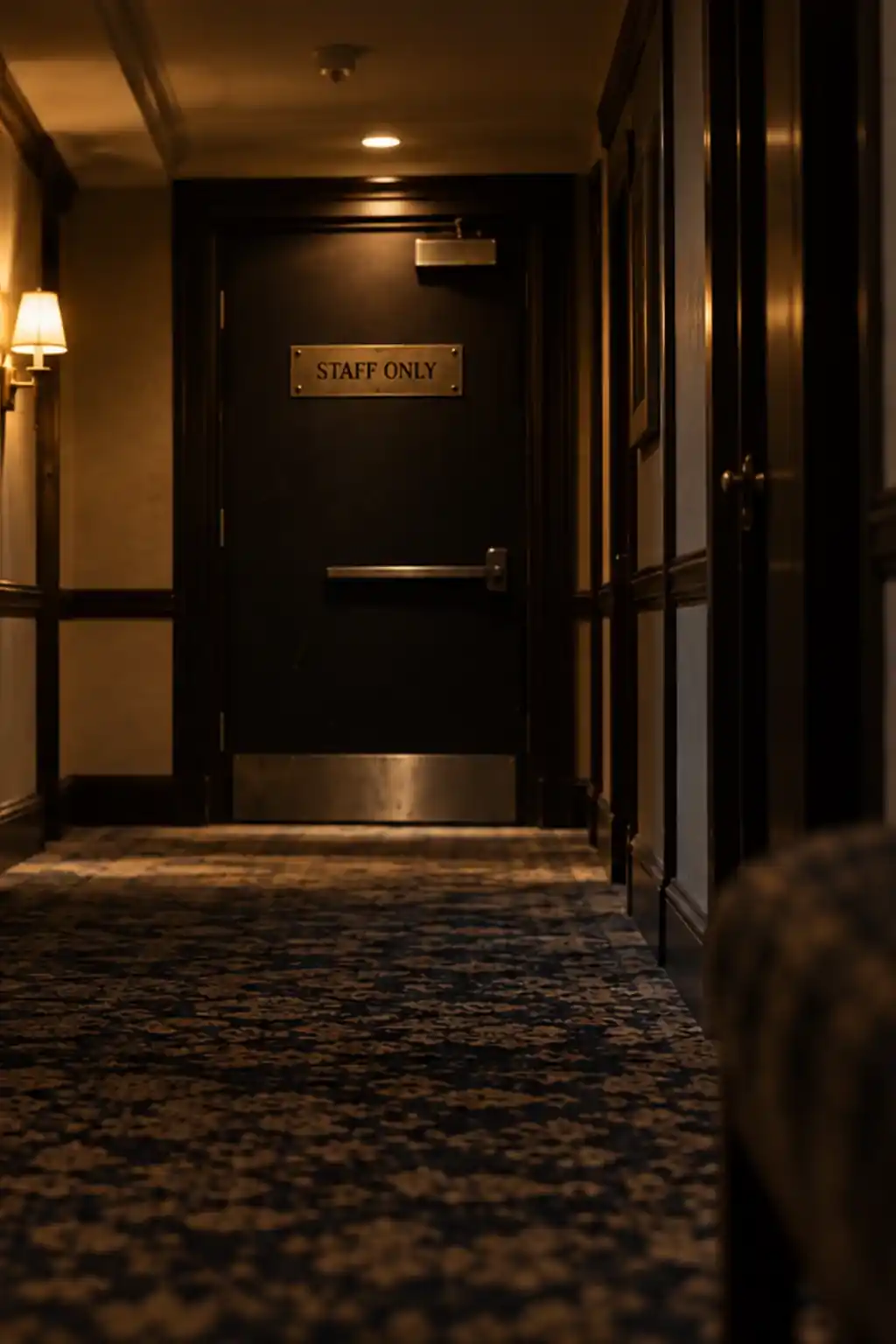
At the bend near the service boundary they had passed earlier, the public carpet stopped at a narrow painted door with a STAFF ONLY plaque. Martin tried the handle once. Locked.
He did not try again.
He looked along the wall instead, then back the way they had come. “The employee passage we were in earlier ran behind the public side for part of the tour.”
“Different floor.”
“I know.”
“So this doesn’t tell us anything.”
“It tells us this building has spaces we can’t see from the guest side.”
Eli raised the camera again. “Which means a sound could move through them.”
“Or a person could be in them.”
“That too.”
Martin bent near the service door and listened at the gap. Nothing distinct came through. He straightened and looked up at the ceiling where a pipe chase disappeared behind a boxed soffit.
“You really want this to be pipes,” Eli said.
Martin kept his attention on the wall. “I want a source.”
Eli’s grip tightened on the camera.
“Earlier tonight you would’ve gone back to the room by now.”
Martin straightened and started walking.
Eli followed. “Now you’re checking every door on the floor.”
Martin did not answer.
Martin stopped at a housekeeping alcove recessed from the corridor. The cart was gone, but a pair of folded towels sat on a shelf beside a plastic bin. A narrow plumbing access panel was set low in the wall. Martin crouched beside it and listened.
Eli aimed the camera at him.
“You’re taking it seriously,” Eli said.
Martin looked up. “We already did this.”
“Not this part.”
“What part?”
“The part where you’re the one who won’t quit.”
Martin stood.
Eli expected a denial. Instead his father looked past him toward the Rider Room.
A knock sounded somewhere down the corridor.
Both men turned.
Several seconds passed.
A second knock came, farther away or softer.
Then, after a gap long enough to break any rhythm Eli could hold in his head, a guest-room door opened near the elevators. A man stepped out carrying an empty ice bucket. He pulled the door closed behind him.
The latch made another hard knock.
Martin exhaled.
“There,” Martin said.
“What?”
“That travels.”
“The door?”
“The first sound could have been a door. Second too.”
“Not the ones in our room.”
Martin did not answer.
“But you relaxed.”
Martin looked at him.
“You did.”
The man with the ice bucket walked past them and continued toward the machine. Eli waited until he had gone around the bend.
“What exactly did you hear in there?”
Martin said, “The knocks.”
“You got up before I even knew what I was listening to.”
Martin glanced toward the camera.
Eli lowered it but did not turn it off.
“What was different?”
“Not now.”
Eli waited, but Martin had already started toward the elevators.
Eli followed him. “If it was just a knock, you wouldn’t be doing this.”
Martin pressed the elevator button.
“We’re on the same floor as the room,” Eli said.
“I know.”
“So where are we going?”
“Nowhere.”
The elevator arrived. Martin did not enter. He listened to the doors open, to the small motor above them, to the soft impact when they reached their stops. Then he stepped back and let them close.
Eli stared at him.
Martin said, “I wanted to hear it from here.”
“And?”
“Not close enough.”
The elevator doors closed between them and the empty cab.
For the next ten minutes they worked their way back toward the room. Martin tested single surfaces without repeating the cadence: wallboard, the wooden trim beside the stairwell, the metal push plate on the public door, the base of the vent grille. Eli recorded each sound. Some carried farther than either expected. One pipe gave a hollow tick after a nearby faucet shut off. A door two rooms away produced a sharp impact that seemed to come from the wall beside them. The elevator produced a low vibration close enough to the earlier rumble that Eli logged it as a plausible analogue.
None of it gave them the sequence from the room.
Eli tried once to prompt the corridor.
“Can you make the same sound again?”
Martin turned on him so quickly that Eli stopped before adding anything else.
“What?”
“We’re checking sources.”
“I know.”
“Then check sources.”
“You’re scared it’ll happen again.”
Martin looked down the corridor.
Eli lowered the camera. An hour ago he would have taken Martin’s silence as victory.
Now Martin looked less convinced than cornered.
Eli lifted the camera again. “Just tell me what changed.”
“Not now.”
They returned to the Rider Room without another knock.
The chairs were still by the window with the round table between them. The bathroom door was open. The fan remained off. The recorder on the dresser was still running, its level bars rising and falling with the small sounds they brought back into the room.
Martin checked the display and then the time.
“We need to charge your camera,” he said.
“That’s it?”
“For now.”
“We didn’t find the source.”
“No.”
“We found ways sound can travel.”
“Yes.”
“But nothing that made that pattern.”
Martin looked at him.
Eli waited.
Martin took off his shoes and sat on the edge of the bed.
Eli plugged the camera charger into the wall beside the dresser. The charging light came on.
He should have felt closer to what he had wanted. Martin had heard the knocks. Martin had searched harder than Eli had and come back without a source.
Yet the ordinary door latch in the corridor had made Martin’s shoulders drop.
The one-then-two in the Rider Room had sent him straight to the walls.
6. The Chair / The Lie
A little after one, Eli came back to the Rider Room and stopped with the door still open behind him.
The camera had been charging on the dresser for most of an hour. Before going downstairs he had stopped the recorder, left the fan off, and let Martin sleep. He had looked once at the two chairs by the window before leaving because he had spent too much of the night learning what happened when he did not look at things first.
They were not where he remembered them.
The round table was still between them, but no longer centered. The chair Martin had used earlier had been pulled away from the table and turned toward the rain-dark window. The other had been pushed closer to the curtain, its front legs no longer parallel with the edge of the rug.
Eli did not move farther into the room.
The bathroom door stood open. The bedspread rose and fell once with Martin’s breathing. Rain tapped the glass in light bursts, and somewhere beyond the wall a pipe gave a single dull tick.
Eli looked at the camera. The charging light was still on.
The last wide shot would tell him whether he remembered the chairs correctly. He could play it back. He could put the old image beside the room now and make the change look clean.
He did not touch the camera.
He crossed to the bed and put a hand on Martin’s shoulder.
“Dad.”
Martin made a sound in his throat and turned away.
“Dad, wake up.”
Martin opened his eyes. For a second he looked past Eli without understanding where he was. Then his face tightened with recognition.
“What happened?”
“Did you move the chairs?”
Martin blinked at him.
“The chairs by the window.”
Martin pushed himself up on one elbow and looked over.
“Yeah.”
The answer came so quickly that Eli almost missed it.
“You did?”
“I woke up. Couldn’t get comfortable.” Martin rubbed his face with both hands. “I sat over there for a few minutes. Pulled one around. Bumped the other out of the way. Then I went back to bed.”
Eli turned toward the window again.
That was all.
Martin watched him wake the rest of the way.
“You thought they moved?”
Eli picked up the camera but did not unplug it.
“I thought we had something.”
Martin sat upright and looked toward the window. “I moved them.”
“You could’ve told me.”
“You were downstairs.”
Eli set the camera back down harder than he meant to. The charger plug shifted in the wall but stayed seated.
“Why did you go straight to the walls?”
Martin’s eyes moved once toward the bathroom.
“There,” Eli said. “That.”
“What?”
“You heard those knocks and you were out of that chair before I even had the camera pointed right. Then you dragged me through half the floor looking at vents and doors and service spaces. You knew why it bothered you.”
“I knew why it bothered me.” Martin’s voice was rough from sleep. “I didn’t know what made it.”
“Then tell me why.”
Martin looked down at the carpet.
Eli felt his pulse in his hands. The anger came faster than the excitement had when he first saw the chairs. “You do this every time.”
Martin looked up.
“You did it when I was a kid.”
Martin’s expression changed before he said anything.
Eli kept going. “You told me that story like it happened. I believed you because you were my dad. Then years later I asked where it came from and you told me you made it up.”
“I know.”
“You told me it happened. Then years later you got to tell me it didn’t.”
Martin put his feet on the floor.
The rain had weakened while Eli was downstairs. Without the recorder running and with both of them still, the sound in the room narrowed to water at the window, the faint electrical hum of the charger, and a distant elevator motor rising and fading somewhere in the building.
“I shouldn’t have done that,” Martin said.
“And now every time I think something happened, you stand there waiting to tell me the part I missed.”
Martin leaned forward, forearms on his knees. “Because I already did this to you once.”
Eli stared at him.
Martin did not look away this time.
“That’s why you came,” Eli said.
“It’s part of why.”
“Not because you thought we might find something.”
“I came because you asked me.”
“That isn’t the same thing.”
“No.”
Eli looked toward the wall Martin had tested first after the knocks. He could still see the sequence of the last hour as clearly as the furniture in front of him: Martin’s palm against painted plaster, his fingers on the vent grille, the locked staff door, the way his shoulders had dropped when an ordinary guest-room latch finally gave him a sound he could place.
“You were scared before we left the room,” Eli said.
Martin said nothing.
“Not after the source hunt. Before it.”
Eli moved closer to the bed. “What did you recognize?”
“Dad.”
“The knocking.”
“I know it was the knocking.”
“The pattern.”
Eli waited.
Martin pressed both palms together between his knees and stared at them. When he spoke again, his voice was quieter.
“One. Then two.”
Eli stopped breathing for a second.
He heard the old story as memory, not words: the part he had carried longest, the small pause that made the second pair feel deliberate. He had known for years that the story itself was false. That knowledge had become broad enough to cover everything in it. He had never gone back and separated which pieces Martin had borrowed, which he had changed, which he had simply invented.
“What about it?” Eli asked.
Martin looked at him.
“I made that part up.”
Eli did not answer.
“Nobody told me that rhythm,” Martin said. “I didn’t read it somewhere. It wasn’t a family story. I made up the knocks.”
Eli shook his head once.
“The whole story was made up.”
“I knew the story was fake.” Eli pointed toward the wall. “I didn’t know that was yours.”
“It was.”
“Completely?”
“Yes.”
“No old version. No story somebody told you.”
“No.”
“You just decided: one, then two.”
“Yes,” Martin said.
Eli turned away from him.
The camera remained on the dresser between them and the window. Its battery icon showed full now. Beside it, the recorder lay dark where Eli had stopped it before leaving. Neither device had been running while the chairs changed position. Neither had been running while Martin slept, woke, sat by the window, and went back to bed.
Eli looked at the wall again.
“That’s why you got up.”
“Yes.”
“You recognized it before I did.”
“Yes.”
“And you didn’t tell me.”
Martin stood. “I wanted another source before I said it out loud.”
“Why?”
Martin took a step toward the window, then stopped beside the displaced chair.
“Because if I found a door or a pipe or somebody in the hall, then I could tell myself I’d put three ordinary sounds together after I heard them.”
Eli looked at him.
“And if you didn’t?”
Martin’s eyes settled on the chair back under his hand.
“I didn’t know what came after that.”
Martin stopped there. He did not offer a pipe, a door, a vent, or another guest as the next possibility.
Eli looked toward the door.
“No one here knows that story.”
Martin shook his head.
“I never told the guide.”
“I know.”
“You didn’t tell anybody.”
“No.”
The charger hummed faintly against the wall.
Neither of them spoke.
A pipe ticked somewhere beyond the bathroom and did not repeat. Rain brushed the window. Farther down the corridor, a door closed with the softened thump they had already tested.
Martin kept one hand on the chair.
Eli watched the wall.
One knock sounded from somewhere near the far side of the room.
Both men turned.
Nothing followed immediately.
Eli did not reach for the camera. Martin did not move toward the wall.
The pause lengthened until Eli felt himself start to doubt its shape, to wonder whether he had already waited too long for the rest of it.
Two knocks followed from somewhere closer to the bathroom.
Not loud.
Not sharp enough to place.
Two distinct impacts with a small space between them.
Martin’s hand left the chair.
Eli looked at him.
Martin was already looking back.
Neither of them moved.
7. Control Test
Neither of them moved.
The camera sat charged on the dresser. Its screen had gone dark from inactivity, but the green light at the charger remained steady. The recorder lay beside it where Eli had left it before going downstairs. Nothing had recorded the three impacts they had just heard.
Martin looked toward the bathroom, then toward the wall where the first knock had come from.
“We’re done.”
Eli kept his eyes on him.
“I mean it,” Martin said. “Turn it off. Get some sleep.”
“It isn’t on.”
“You know what I mean.”
Martin crossed to the dresser and unplugged the camera. He wound the cord once around his hand, too tightly at first, then loosened it and set it beside the charger. Eli watched him do it. Twenty minutes earlier Martin had been tearing through the floor trying to find a door, a pipe, a vent, anything that could make the sounds. Now his movements had the opposite purpose. Camera away. Cord away. Investigation over.
Eli looked at the room.
The two chairs were still displaced, but there was nothing left in them to investigate. Martin had moved them. The fact had survived the argument exactly as it had started: ordinary.
The knocks had not.
“If I leave,” Eli said, “and it happens again—”
Martin turned. “No.”
“Listen.”
“No.”
“If I leave you here and walk the hall, then there are three possibilities.”
“There are about three hundred possibilities.”
“I’m not saying it proves anything.”
“That usually comes right before you tell me what something proves.”
Eli let that pass.
“If you hear it in here while I’m gone, that matters. If I hear it out there and you don’t, that matters. If neither of us hears it, that matters too.”
Martin rubbed his eyes with thumb and forefinger.
“You’re still in the same building.”
“I know.”
“There are still people in the building.”
“I know.”
“Pipes. Doors. Elevators. Somebody dropping a shoe two rooms over.”
“I know.”
“And if you hear three noises in the hallway, you don’t get to call them the same three noises because you want them to be.”
“I know.”
Martin lowered his hand.
Four times he had answered I know without pushing back. He kept his eyes on Martin and left the possibilities separate.
Martin glanced at the door.
“One walk,” Eli said. “I stay on this floor. I don’t go behind anything locked. I don’t ask it to knock. You stay here. We see what happens.”
“We see what happens,” Martin repeated. “That’s all.”
“That’s all.”
“And if nothing happens?”
“I come back.”
Martin stepped away from the dresser. Eli took the opening.
He took the camera, checked the battery, and turned it on. The night-vision image opened in a grainy wash over the room. He filmed the time on his phone, then Martin standing near the bed.
“Dad stays in the room,” he said to the camera. “I’m walking the guest hallway. We’re not reproducing the knocks. We’re not prompting for them.”
Eli opened his equipment pouch for the handheld light and saw the lollipop.
He had forgotten about it.
The guide had given it to them on the tour hours earlier, along with the story about children in the upper corridors and guests leaving candy for them. Eli had put it away because he had planned to try it after the room session.
He held the pouch open for a second before taking the candy.
He picked it up anyway.
Martin noticed.
“Seriously?”
“I was already going to use it.”
“For the kids.”
“For the story about the kids.”
“That sounds different to you?”
“Tonight it does.”
Eli slid the wrapped candy into his jacket pocket.
Martin stared at him.
“It’s not the test,” Eli said. “I’m taking it because I already brought it.”
“Good distinction.”
“You want me to leave it?”
“I want you to go to bed.”
Eli opened the door.
Martin did not try to stop him.
The corridor outside looked smaller through the camera than it had during the source hunt. The lens flattened the distance between the repeating doors and compressed the bends in the hall until the far end seemed almost close enough to touch. In person, Eli could still feel the length of it in his legs.
He turned back once.
Martin stood inside the room with one hand on the door edge.
“One walk,” he said.
Eli nodded.
Martin let go.
Eli pulled the door nearly shut, leaving Martin alone on the other side.
For the first minute, Eli recorded plenty and heard nothing resembling the pattern.
Ventilation moved steadily through the ceiling grilles. Somewhere below him, water ran through a wall in a long descending rush. An elevator motor started, carried vibration into the floor, then stopped. A few seconds later came the soft mechanical clunk of doors opening somewhere he could not see.
Eli walked past the first guest-room door and listened.
Nothing.
The second.
Nothing.
At the third he heard a television, low enough that he could not make out words.
He moved on.
The camera clock advanced.
He passed the stretch where he and Martin had tested the transmitted door sounds earlier. He stopped there and listened long enough for his breathing to become the loudest thing on the camera microphone.
A pipe clicked.
Then nothing.
He waited.
No second or third impact followed.
Eli continued.
He kept the camera pointed ahead instead of at himself. When he spoke, he kept his voice low.
“Still on the fourth floor. Dad’s still in the room. No knocks.”
He almost added no activity and stopped himself.
There had been activity. The elevator. Plumbing. A television. Air through vents. What he meant was that none of it had matched what he was testing.
At the next bend he took the lollipop from his pocket.
The wrapper made a dry crackle that sounded enormous in the empty hall.
Eli held it by the stem in front of the lens.
“This is the candy the guide gave us earlier.”
He paused.
The old version of the test came back to him automatically. Ask the children to move it. Ask them to come play. Repeat what the guide had told him and wait for something to fit.
He looked down the corridor.
Instead he said, “I’m holding it still.”
That was all.
He waited.
The candy did nothing.
Thirty seconds passed.
Then another thirty.
His shoulder began to ache from holding the camera chest-high. He shifted his grip. Somewhere far off, a guest-room latch clicked and a door opened. Eli heard several footsteps, then the elevator call button chimed.
Human movement.
He filmed the empty stretch ahead until the elevator carried whoever it was away.
The lollipop still hung from his other hand.
Eli walked on.
At the junction where the guest corridor bent toward the side of the floor connected to the service route, his stomach tightened.
He stopped.
The sensation came quickly enough that for a moment he thought he had stood up too fast, though he had been walking steadily for several minutes. Heat gathered behind his jaw. His mouth filled with saliva.
He lowered the camera.
“Okay.”
He leaned one shoulder against the wall and breathed through his nose.
The nausea strengthened, then held.
He turned the camera toward his face only long enough to document it.
“Just got nauseous here. At this junction.”
He swallowed.
“I don’t know why.”
No colder here that he could tell. No visible change in the light. No sound apart from the ventilation and a low mechanical vibration he could feel more easily through his shoulder against the wall than through his shoes.
He moved away from the wall.
The nausea did not vanish.
He walked several paces back the way he had come.
Waited.
It eased a little.
He returned to the junction.
His stomach turned again, though not as sharply.
Eli looked at the camera screen.
“That could be me expecting it now.”
He stopped recording commentary and simply left the camera running.
After another minute the feeling weakened enough that he could stand normally.
The lollipop was still in his left hand.
He had almost forgotten it.
He lifted it again, pinching the stem between thumb and forefinger. The wrapper reflected the infrared light in a pale flare.
Nothing happened.
He lowered his hand.
The stem slipped sideways between his fingers.
Eli closed his hand around it before it fell.
He froze.
He stared at his own hand.
The stem had shifted between his fingers. That much had happened. He did not know whether the wrapper had caught his sleeve, whether his grip had loosened when he lowered his arm, whether a current of air had touched the broad plastic around the candy, or whether he had moved without noticing.
He repositioned his hand in front of the camera.
“That almost came out of my fingers.”
He waited.
Nothing.
He held it the same way again.
Nothing.
He moved his wrist down deliberately.
The wrapper brushed the cuff of his jacket.
He tried it twice more and could not make the candy slip in quite the same way.
Eli put it back in his pocket.
He did not ask anyone to do it again.
By the time he reached the far stretch of guest corridor, he had more ordinary noise on the recording than anything he could use.
Water moved somewhere behind the wall. A door shut at the far end. The elevator motor started again. Any three impacts he heard out here would still have sources he could not see.
He checked the camera clock.
More than twenty minutes.
No private cadence.
He walked back toward the junction at half his earlier pace.
He stopped prompting entirely.
He heard a fan somewhere behind a wall, a faint rush that could have been water, the small expansion clicks of old material changing temperature. Once, a dull impact came from below him.
Only one.
Eli waited for the rest.
Nothing followed.
He continued.
Five minutes later he sat on the edge of a narrow bench near the turn in the corridor and rested the camera against his knee. The nausea had dwindled to a faint uneasiness in his stomach. His hand had stopped shaking enough that he could read the remaining battery time without the numbers blurring.
The lollipop stayed in his pocket.
“No pattern,” he said quietly.
He considered saying the test had failed.
Martin could be hearing the rhythm in the room right now. Or nothing could be happening there either. Eli would not know until he went back.
He raised the camera.
“I’m going back in a minute.”
He stopped talking.
At first he thought the sound was water.
It came from somewhere beyond the bend to his left, faint enough that he could hear it only in the gaps between the ventilation cycles. A rising sound, then another beneath it.
Eli lifted his head.
The sound stopped.
He stood without moving his feet.
Nothing.
He brought the camera up and pointed it toward the bend.
Twenty seconds passed.
Then something sounded again.
Not a knock.
Not plumbing, at least not in the way the plumbing had sounded anywhere else that night.
A thin human register reached him from farther down the corridor—more than one tone overlapping, or one voice changing pitch. Too distant for words. It might have been talking. It might have been crying.
He remembered what the guide had told them about children in the upper corridors.
The word came immediately.
Children.
Eli did not say it.
He moved toward the bend.
The camera stayed aimed ahead.
“Human-sounding,” he whispered. “Farther down.”
He listened.
Nothing repeated.
He reached the first door and stopped beside it, keeping his body clear of the threshold. No television. No conversation. No movement he could hear through the wood.
The next door was equally quiet.
He continued.
The sound had seemed to come from the side of the floor that led back toward the service route they had walked earlier, but the corridor gave him no clean line to it. Guest doors interrupted one wall. The other turned around a structural section before narrowing toward the junction they had examined with Martin. Somewhere beyond that were staff spaces he could not enter.
Eli stopped at each door long enough to listen.
Nothing.
At the final bend, he heard the sound once more.
Brief.
Faint.
A wavering human noise from somewhere ahead.
He raised the camera but did not speak.
No name.
No age.
No story.
He followed it toward the service-passage side of the floor.
8. Martin Follows
Martin waited until he could no longer hear Eli’s footsteps.
Without Eli in the room, Martin noticed the ordinary sounds more clearly: ventilation moving through the ceiling grille, rain brushing the window in uneven passes, water passing through the bathroom wall with a low intermittent rush. The charger remained unplugged on the dresser. The recorder lay dark beside it.
He looked at the door and checked the time on his phone.
Twenty-eight minutes.
Eli had said one walk.
Martin set the phone facedown on the bedside table. He had not meant to keep track at first. Eli was an adult walking an occupied guest floor with a camera and a flashlight. There was no practical reason to treat the separation like an emergency.
That had not stopped Martin from checking the time four times.
He sat in the chair he had moved earlier and listened deliberately. A door closed somewhere beyond the room. The impact reached him softly through the wall. An elevator motor started and stopped. Pipes clicked twice behind the bathroom.
None of it had the cadence.
Martin leaned forward with his forearms on his knees. He understood what Eli was trying to do, and understanding it did not make the experiment good. If something happened in the room, they still would not know where it came from. If Eli heard three impacts outside, he could not remove the other guests, the plumbing, the service spaces, or the ordinary sound paths they had already failed to map. If nothing happened, that might tell them nothing at all.
Twenty-nine minutes.
Martin opened the message thread on his phone and typed:
Come back.
He left the words unsent. Calling Eli back because he had grown tired of waiting would give him another reason to say they had ended the test before anything had a chance to happen.
Martin deleted the message.
Thirty minutes.
He stood. The carpet still held the old chair marks, one set no longer aligned with the furniture because he had moved it during the charging gap.
That mistake, at least, had a source.
He crossed to the dresser and looked at the recorder. He could turn it on, but Eli had stated the conditions before leaving: Martin stayed in the room, Eli walked the corridor, neither of them prompted for the cadence, and neither reproduced it. Martin intended to preserve those conditions because he wanted the exercise finished cleanly.
He went as far as the bathroom doorway. The light was off. The door stood partly open. He looked toward the wall where the earlier knocks had seemed closest, then stopped before touching it.
They had already tested that surface.
Martin returned to the bed and sat.
Thirty-two minutes.
A low thump sounded somewhere beyond the far wall. He looked up. The sound did not repeat, and he let it go.
After every isolated impact, Martin found himself counting the silence. He stopped only when enough time had passed that the next sound could no longer belong to it.
Martin had spent years telling Eli how easily people assembled sequences afterward.
Now he was doing it himself.
Thirty-three minutes.
One knock came from the hallway side of the room.
Martin turned toward the door.
The sound was not loud. It had the compact quality of something striking a hard surface beyond the wall or door.
He waited.
Ventilation continued overhead. A pipe gave a faint metallic tick behind him.
The pause lengthened.
Two knocks sounded.
Close together.
Martin stood so quickly that the chair dragged against the carpet.
He did not move toward the door at first. He listened for Eli’s voice, footsteps, the camera strap against a wall—anything human and immediate.
Nothing.
Thirty-four minutes.
Martin crossed the room and stopped with his hand near the latch.
“Eli?”
No answer.
He opened the door.
The corridor was empty.
Martin looked left, then right. No camera light. No movement. The nearest guest-room doors were shut, and the far bend blocked the section Eli had taken.
“Eli?”
Nothing came back.
His first thought was that Eli had returned, knocked the cadence, and moved away before Martin opened the door.
Irritation came first.
If Eli had done that, the test was over for a different reason.
Martin stepped into the doorway.
“Very funny.”
No answer.
A television murmured behind a door farther down. Air moved through the corridor vents. An elevator chimed somewhere around the bend.
He could walk twenty feet, look around the nearest corner, and settle it.
He stayed where he was.
The agreement had been that he remained in the room.
Martin went back inside and left the door open. If Eli returned, he would hear him.
A minute passed.
Then another.
No Eli.
Martin called him.
The phone rang once, twice, three times. No ringtone answered from the corridor near the room.
He ended the call before voicemail and checked for a message.
Nothing.
He typed:
Where are you?
This time he sent it.
Delivered.
Martin put the phone in his pocket and looked toward the open doorway. The knocks had seemed to come from the hall side of the room. That was as far as he could take it. He could not place them at the door. He could not prove Eli had made them. He could not tell whether the intervals had been exact or merely close enough for recognition.
One.
Then two.
His own stupid detail.
Martin stepped into the corridor again and pulled the room door nearly shut behind him without letting it latch.
He walked ten paces and stopped to listen.
The television farther down had gone quiet or dropped too low to hear. He reached the first bend.
Empty.
The corridor continued toward the service-side junction they had examined earlier.
Still no reply from Eli.
Martin called again. Four rings.
Nothing.
“Eli.”
His voice carried farther than he expected.
No response.
He almost started forward.
One knock sounded farther down the corridor.
Martin stopped.
His first impression put it somewhere ahead of him, but they had already learned how unreliable that impression could be. Door impacts had carried through walls. Elevator vibration had appeared in places that did not match its source. Sound moved through the floor in ways neither of them had mapped.
He waited.
The pause stretched long enough for him to feel his grip tightening around the phone.
Two knocks.
Farther away.
Martin stayed still.
Eli remained the easiest explanation. Eli knew the cadence now. He knew why it mattered. He could have decided that reproducing it outside the room would tell him something about Martin’s response.
Except Eli had explicitly said they would not reproduce it.
Martin looked at the blank phone screen.
No answer to either call.
“Eli?”
Nothing.
Martin walked.
Not fast, but he did not stop at the first guest-room door. At the second, a television produced a brief burst of laughter before returning to indistinct dialogue.
Human source. Ordinary enough.
He continued toward the service-side junction.
At the next bend he slowed. If Eli had made the knocks, following rewarded the trick. If Eli had not, Martin was still letting the sequence decide where he walked—the exact mistake he had warned Eli about all night.
He kept walking anyway.
The carpet changed near the bend. The corridor narrowed slightly where the wall jogged around a structural section. Beyond it lay the route toward the service passage they had entered with the guide and the staff boundary they had tested later.
Martin stopped before the turn.
A faint sound came from beyond it.
Human register.
For a second he thought Eli had spoken. The sound thinned before Martin could make out a word.
“Eli?”
No response.
He stepped around the bend.
The corridor ahead was empty.
Farther down, near the junction, a pale rectangle of camera light moved across the wall.
Martin exhaled.
“Eli.”
The light stopped.
A figure turned.
Eli stood near the service-side junction with the camera raised.
“What are you doing out here?”
Martin walked toward him.
Eli lowered the camera halfway.
“I heard something.”
“So did I.”
Eli’s expression changed.
Martin stopped several feet away.
“You heard the voices?” Eli asked.
“What voices?”
Eli stared at him.
“The knocks,” Martin said.
Eli lowered the camera another inch.
“Where?”
“Outside the room.”
“You were in the room?”
“Yes.”
“And you heard it outside?”
“I heard one. Then two. Hall side.”
Eli looked back in the direction Martin had come from.
Martin continued before Eli could attach anything else to it.
“I opened the door. Nobody there. I thought it was you.”
“It wasn’t.”
“I called you.”
Eli took his phone from his pocket. The screen lit his face.
“Two missed calls.”
“Yeah.”
“I had the camera running.”
“That doesn’t tell me where you were every second.”
Eli looked up.
Martin heard how the sentence sounded.
“I’m not saying you did it.”
“I didn’t.”
“I know.”
“No, you don’t.”
Martin stopped.
Eli broke eye contact and looked down the corridor.
“I heard something over here,” he said. “Like people talking. Maybe crying. I couldn’t get words.”
“Guests?”
“Could be.”
“Rooms?”
“I checked what I could hear from the hall.”
Martin waited for the rest.
Eli did not give him a child, a room name, or a ghost story.
“What did you call it?”
“Human-sounding.”
“That’s it?”
“That’s it.”
Neither man said children.
Martin took out his phone and showed Eli the elapsed time.
“You were gone almost forty minutes.”
“I know.”
“You said one walk.”
“I got turned around following the sound.”
“You didn’t get turned around.”
“No.”
Martin put the phone away.
Eli lifted the camera again.
“You heard the pattern twice?”
“Once outside the room. Then again farther down.”
“Same timing?”
Martin hesitated.
“Close enough that I recognized it.”
“Exactly?”
Martin looked at him.
Eli waited.
“No,” Martin said. “I didn’t time it.”
Eli nodded.
Martin glanced at the camera.
“You get yours?”
“Not the knocks.”
“The voices.”
“Some of it, maybe. I don’t know what the mic picked up.”
Martin looked toward the service boundary. The corridor remained empty. Ventilation moved overhead, and a faint mechanical vibration passed through the wall near his shoulder.
He should have told Eli they were going back. The separation had produced two different reports under bad controls. Eli had heard distant human-sounding noise. Martin had heard the cadence. Neither event explained the other, and neither gave them a source.
That was enough.
Martin opened his mouth.
One knock sounded from beyond the closed staff door beside the junction.
Both men turned.
Martin stopped breathing.
Eli raised the camera.
Neither spoke.
The pause began.
9. The New Sequence
The pause lasted long enough for Eli to hear the ventilation above them.
Then two knocks came from beyond the closed staff door.
Close together.
Eli kept the camera pointed at the door.
Martin did not move.
They listened. The corridor continued around them as it had all night: low mechanical vibration through the wall, air through the ceiling vents, a faint plumbing sound somewhere farther along the floor.
Nothing else followed.
Eli looked at Martin.
Martin was staring at the staff door.
“You heard all three.”
It was not a question.
Martin nodded.
“From there?”
“That’s where it seemed.”
Eli adjusted his grip on the camera. “Same place for you?”
Martin glanced at him. “Door side.”
“Me too.”
Neither of them said exactly.
Eli moved closer to the boundary, stopping short of the handle. The door was the same one they had checked during the earlier source hunt: staff access, closed to them, no window, no reason to assume the corridor continued directly behind it in the direction the sound seemed to suggest.
He aimed the camera at the frame and then down at the threshold.
“No prompt,” he said quietly. “We didn’t say anything before that.”
Martin looked at him.
“I’m logging it.”
“Then log what happened.”
Eli nodded.
“One knock at the end of the last section. Pause. Two more. Both of us facing the same door.”
Martin’s eyes shifted to the camera.
“Sounded like the same door.”
Eli corrected himself. “Sounded like it came from this side.”
Martin nodded.
They waited.
Nothing repeated.
A minute ago Eli had been trying to determine whether the voices were coming from a guest room, the service passage, or somewhere he could not see. Martin had been following the knock pattern from the opposite direction. Now both trails had ended at the same locked boundary, and the only thing they shared was the last sequence.
Eli stepped to one side of the doorway and listened with his head turned slightly, trying to separate whatever came through the door from whatever travelled through the adjacent wall. Martin crouched and looked at the gap beneath it.
“Anything?”
Martin shook his head.
Eli moved to the other side. The camera microphone would get the impacts if they were loud enough. It would not preserve what the corridor had sounded like around them or how sharply the last two knocks had seemed to sit against everything else.
He touched the painted wall beside the frame with two fingers.
No vibration he could distinguish.
“What are you doing?” Eli asked.
“Looking.”
“For what?”
“Light. Feet. Anything moving.”
There was a thin dark line beneath the door and nothing more.
Martin stood, tried the handle, and released it when it did not move.
“Locked.”
“We knew that.”
“I know.”
He pressed his ear near the door without touching it. He stepped back.
“Nothing.”
“Could be a service corridor.”
“Could be a room.”
“Could connect back toward the elevators.”
“Could do a lot of things.”
Eli looked along the wall.
“We don’t know.”
“No.”
Eli lowered the camera slightly.
They had reached the same problem that had stopped them earlier. The hotel did not belong to them. A staff door was not permission to enter because something interesting had happened behind it. They had no floor plan, no staff movement log, no access to whatever mechanical spaces might lie beyond the wall.
“We go back.”
Martin did not answer.
Eli turned toward him.
At the start of the night, Martin would already have been walking.
Now he was still looking at the door.
“Dad.”
Martin raised one hand.
“Wait.”
Eli stopped.
They listened again.
Ten seconds.
Twenty.
Nothing.
Somewhere well outside their immediate section, a door shut. The sound came through the corridor as a dull impact without any useful direction.
Martin looked toward it, then back at the staff door.
“That wasn’t it.”
“I know.”
Thirty seconds.
The silence after the shared cadence had lasted long enough that Eli could feel the adrenaline beginning to drain from his hands. His fingers were stiff around the camera grip.
Martin stepped closer to the door.
Eli watched him place two fingers against the painted surface.
Not his ear.
His knuckles.
Eli knew what he was about to do before Martin moved.
“Dad.”
Martin looked back.
Eli could have stopped him.
Instead he kept the camera raised.
Martin turned to the door.
He knocked once.
The sound was harder and flatter than the ones they had heard.
He waited.
Then he knocked twice.
Eli felt the old rhythm before he consciously counted it.
One.
Then two.
Martin dropped his hand.
Neither spoke.
The gesture looked different coming from him than it ever had in Eli’s memory.
Eli looked at the camera screen.
The red recording indicator remained steady.
He looked back at the door.
Nothing followed.
Five seconds.
Ten.
Martin shifted his weight.
At fifteen seconds he rubbed the side of his thumb against his forefinger. Eli knew the gesture as one of his father’s old waiting habits.
Twenty seconds.
The longer nothing happened, the smaller the knock-back became.
A man tapping on a staff door in the middle of the night.
Eli almost lowered the camera.
Martin exhaled through his nose.
“Well.”
Eli looked at him.
Martin gave the slightest shake of his head.
Eli lowered the camera a few inches.
One knock sounded behind them.
Both turned.
The impact seemed to come from behind them.
Or the wall beside it.
Or somewhere beyond the bend.
Eli raised the camera again.
The pause followed.
Martin took one step away from the staff door.
Two knocks.
Close together.
Eli checked the camera screen.
Still recording.
Martin turned fully toward the corridor.
“That was behind us.”
“I thought farther left.”
Martin pointed toward the bend. “No. Back toward the guest hall.”
“I heard it closer to the wall.”
“That wall goes back toward the guest hall.”
“You don’t know what’s behind it.”
Martin stopped.
Neither interpretation gave them a source.
Eli moved toward the bend and aimed the camera down the open corridor.
Empty.
Martin came beside him.
“Anybody there?”
Eli looked at him.
Martin had called out, not Eli.
No one answered.
They waited.
A faint mechanical hum continued somewhere beyond the wall.
Martin walked to the first accessible guest-side junction and stopped. Eli followed, keeping him in frame.
“No staff door here,” Eli said.
“I can see that.”
“Guest rooms start there.”
“I know.”
Martin listened at the bend.
Nothing moved.
Eli swept the camera slowly across the corridor. Closed doors. Wall vents. Carpet. The service-side wall. No visible person.
“Which direction did you hear?”
Martin pointed.
“Down there.”
Eli pointed a little closer to the wall beside them.
“I had it here.”
“That’s not the same place.”
“No.”
Martin looked from Eli’s hand to the corridor.
Eli stepped to the wall and listened.
Nothing.
He checked the nearest unlocked public door.
A linen alcove.
Empty shelves on one side, folded towels on the other.
No person.
Martin looked past him.
“Does that connect?”
“No.”
“You sure?”
Eli angled the camera inside.
“Ends right there.”
Martin moved farther down the corridor.
Eli followed.
“Dad.”
Martin stopped at another junction.
“What?”
“We’re done.”
Martin looked back toward the staff door.
“You heard that.”
“Yes.”
“After I knocked.”
“Yes.”
“From somewhere else.”
“Somewhere we couldn’t see.”
Martin stared at him.
Eli kept the camera lowered between them now.
“You know what I mean.”
Eli looked toward the corridor instead of answering.
Martin waited, then looked away.
“We don’t know what’s behind that door. Somebody could be awake up here. We’ve spent half the night hearing doors through walls, and we can’t even agree where those knocks came from.”
Martin pointed toward the corridor.
“So we check.”
“We did.”
“We checked one turn.”
“And then what?”
Martin said nothing.
Eli waited.
“Another hall?” he said. “Another door? Another floor? You knock again if nothing happens?”
Eli kept his voice low.
“That’s what I was doing.”
Martin looked at him.
Martin’s eyes dropped to the camera at Eli’s side.
Eli raised the camera slightly, then thought better of it and let it hang at his side.
“We got it.”
“Got what?”
“The sequence.”
“That’s not why I’m still standing here.”
“I know.”
Martin stopped rubbing his thumb against his forefinger.
Behind them, the staff boundary remained closed.
Nothing knocked again.
Martin looked toward it.
Then he turned back to Eli.
“You really want to stop now.”
“Yes.”
“After that.”
“Yes.”
Martin rubbed his thumb against his forefinger again.
Eli waited.
At last Martin nodded.
“Okay.”
Eli did not move immediately.
“You mean it?”
“I said okay.”
Martin started back toward the Rider Room.
Eli fell into step beside him.
They had gone perhaps ten feet when Martin glanced over his shoulder.
Eli saw it.
“Don’t.”
Martin faced forward again.
They kept walking.
Neither of them knocked again.
10. Raw Audio
By the time the windows began to gray, Eli had copied the camera files to his laptop and lined the batteries along the desk to charge.
Martin sat on the edge of the nearer bed with his shoes on.
Neither of them had slept.
The Rider Room looked ordinary again in the weak morning light. One chair remained where Martin had admitted moving it. The other sat at the angle Eli had found when he came back from charging the equipment.
He looked at them once while the first video loaded. The chairs were done. Whatever he had thought when he saw them out of place belonged to the gap in the recording and to the few seconds before Martin answered his question. Martin had moved them. Nothing they had heard afterward changed that.
Eli put on his headphones.
“You want these?”
Martin shook his head. “Play it out loud.”
Eli unplugged them.
The laptop speakers filled the room with the smaller version of the night.
Ventilation.
Fabric against clothing.
The low handling noise of Eli changing his grip on the camera.
His own voice, too close to the microphone.
Martin’s voice farther away.
They listened through part of the room session first.
The overhead rumble that had seemed to move through the ceiling during the investigation came through as a broad low vibration.
Martin leaned toward the computer.
“That one.”
Eli stopped the file.
“The rumble?”
“Yeah.”
He backed it up and played it again.
Through the laptop speakers it sounded less directional than Eli remembered. A low rolling sound, followed by a softer vibration and the scrape of someone moving in the room.
Martin pointed toward the screen.
“That could be the same thing we heard near the elevator.”
“Could be.”
“Or plumbing.”
“Could be.”
Eli marked the time in his notes.
He did not write explained.
Martin noticed.
“You’re not calling that one?”
“No.”
“Why?”
“Because we didn’t find the source.”
Martin considered that.
Eli added, “But I’m not putting it in a clip like it came out of nowhere either.”
Martin nodded.
They moved forward.
A door clicked somewhere in the recorded corridor.
A guest voice crossed the microphone too faintly to make out.
The elevator mechanism produced a brief vibration that both of them recognized immediately.
Martin said, “That’s useful.”
Eli looked at him.
“What?”
“Having the ordinary ones.”
Eli almost laughed.
“You spent half the night complaining that I recorded too much.”
“I complained that you talked too much.”
“That’s different?”
“Yes.”
Eli let the file continue.
For a few minutes they were father and son watching badly framed hotel footage before breakfast, correcting each other about which sound belonged to which hallway.
Then the first knock sequence came.
One impact.
A pause.
Two more.
Eli stopped moving.
Martin did too.
On the laptop, the sounds were dull. That was the first thing Eli noticed. Not quiet or hidden. Dull. Three short impacts with none of the shape the room had seemed to give them at the time.
He played the section again.
The first knock came through clearly enough.
Then the pause.
Then two.
Martin looked toward the wall where they had first heard them hours earlier.
Eli watched him do it.
“Sounds different,” Martin said.
“From what?”
“Being here.”
Eli replayed it.
The laptop gave them no useful distance. No convincing wall. No bathroom side. No sense that the final two had come from somewhere different than the first.
Just impacts captured from one recording position.
Eli opened the waveform and enlarged the section.
Martin leaned over.
“You can tell anything from that?”
“I can tell where the sound is in the file.”
“That’s not what I asked.”
“No.”
Eli zoomed back out.
He listened once more without watching the screen.
One.
Pause.
Two.
He could still hear the old rhythm.
He could not tell whether he would have heard it that way if he had not already known what to listen for.
Martin sat back.
“Can you measure the gap?”
“Yeah.”
Eli reached for the trackpad, then stopped.
“What?”
Martin waited.
Eli looked at the three visible peaks.
“I can measure what the microphone got.”
“That’s what I meant.”
“I know.”
He checked the approximate spacing, then wrote it down without announcing it as a verdict.
The peaks gave him intervals in the recording. They could not tell him how either man had grouped the sounds before recognizing the pattern.
The recording could tell him when the impacts reached the microphone. It could not tell him what surface made them, how far away that surface had been, or whether the apparent spacing had carried the same shape before two tired people recognized it.
Martin read the number over his shoulder.
“That prove anything?”
“No.”
“Rule anything out?”
“No.”
Martin nodded.
Eli continued through the night.
The post-confession recurrence was not there.
They both knew why.
The camera had been charging.
The recorder had not been running.
There was only their memory of sitting in the room after Martin said the rhythm had come from nowhere but him, and then hearing it. Eli had nothing to play back.
He marked the gap anyway.
Martin watched him.
“You writing that we heard it?”
“Yes.”
“Without a recording.”
“Yes.”
“Good.”
Eli glanced at him.
Martin looked toward the laptop rather than back.
The separation test came next.
Long corridor footage.
Ventilation.
An elevator.
A television behind a guest-room door.
Eli’s breathing when the nausea started.
His voice describing where he stood.
The faint sound of the lollipop wrapper against his hand.
Nothing in the recording made the candy movement more useful than it had been while he was holding it.
When they reached the voice-like section, Eli raised the volume slightly.
Martin leaned closer.
At first there was only the corridor.
Then something faint entered under the ventilation.
Eli stopped the file.
“Here.”
He backed up.
They listened again.
A wavering sound.
Human-sounding.
Maybe.
It rose briefly, separated into something like two overlapping tones, and faded.
Martin frowned.
“That’s what you followed?”
“That’s part of it.”
“Can you get words?”
“I couldn’t then.”
Eli played it again.
The tour guide’s stories were still available in his memory. Children in the upper corridors. Voices. Candy.
The words were available too.
If he wanted them.
He did not say them.
Martin leaned toward the speaker.
“Again.”
Eli replayed it.
Martin shook his head.
“I don’t have anything.”
“Talking?”
“Maybe.”
“Crying?”
Martin waited longer before answering.
“Could be.”
Eli lowered the volume.
He did not open an audio filter.
He did not type a candidate phrase into the notes.
The sound had reached him after hours of hearing the hotel described in advance, after repeated listening, after the lollipop, after nausea, after the private cadence had already changed what both men were waiting for.
Whatever the microphone contained, Eli no longer had a first listen to give it.
He wrote:
Human-sounding audio. No stable words.
Martin read it.
“That all?”
“That’s all.”
They moved to the final corridor file.
Eli knew the section before it arrived.
He knew the exact camera movement, the staff door entering frame, Martin’s hand against the painted surface.
He knew what came after.
On the recording, Martin knocked once.
The microphone caught it hard and close.
Pause.
Two knocks.
Those were hard and close too.
Martin watched himself lower his hand.
Neither of them spoke in the video.
The corridor noise continued.
Five seconds.
Ten.
Fifteen.
Twenty.
Eli could hear the slight movement of Martin’s shoes.
Then Martin’s recorded voice:
“Well.”
A moment later, the first new impact sounded.
Eli’s hand stopped on the trackpad.
Martin leaned forward.
The laptop speaker gave them a dull knock.
Nothing about it sounded as far behind them as Eli remembered.
Nothing about it sounded clearly left.
Nothing placed it near the guest hall.
The microphone had captured an impact.
That was all.
The pause followed.
Two impacts.
Martin stared at the screen.
Eli did not stop the playback.
Their recorded voices came next.
“That was behind us.”
“I thought farther left.”
The recording preserved their disagreement more clearly than either man’s sense of direction.
Martin pointed at the laptop.
“There.”
“I hear it.”
“It’s the same cadence.”
Eli let the footage continue through their corridor check, the open linen alcove, the empty visible hall, Martin trying to move farther, Eli stopping him.
When the video reached Martin’s “Okay,” Eli paused it.
They listened to the fan in the room above the quiet laptop.
Martin said, “Back it up.”
“To the knocks?”
“Yes.”
Eli did.
They listened again.
Martin’s deliberate sequence.
The wait.
The later three impacts.
Again.
Martin leaned closer on the third pass.
Eli watched his face rather than the screen.
“What?”
“I’m trying to hear whether the second set is farther from the camera.”
“You can’t get distance like that from this.”
“I know.”
Martin sat back.
Eli closed the waveform.
“You can hear the knocks.”
“Yes.”
“You can hear the timing.”
“Yes.”
“You can hear us disagree about where they came from.”
Martin looked at him.
“Yes.”
Eli waited.
Martin rubbed his thumb against his forefinger.
He did not say answer.
He did not say ghost.
He looked instead at the row of file names in the folder.
“Send me those.”
Eli thought he meant the clips.
“Which ones?”
“All of it.”
“The whole night?”
“The raw files.”
Eli looked at him.
Martin shrugged once.
“I want to hear it on my own headphones.”
“You know I can make you a shorter—”
“No.”
Martin tapped one finger on the desk.
“Raw.”
Eli turned back to the laptop.
At the beginning of the night, that request would have felt like winning.
He opened the transfer window instead.
The progress bar began to move.
Martin stood and picked up his bag.
“You sending the camera originals too?”
“Yes.”
“Not the export?”
“The originals.”
“Good.”
Eli watched the first file finish.
Outside the window, the mountain had begun to separate from the low clouds. Cars moved through the wet parking lot below. Somewhere in the hallway a housekeeping cart struck a doorframe, followed by a woman saying something Eli could not make out.
Neither man turned toward the sound.
Martin zipped his bag.
“What are you going to say?”
Eli looked at him.
“About what?”
“The video.”
Eli glanced at the laptop.
The transfer continued.
“I don’t know yet.”
Martin nodded.
No challenge.
No correction.
Eli looked once more at the chairs.
One had been moved by Martin.
Some of the sounds from the night resembled ordinary noises they had found elsewhere in the building.
The distant voice-like recording still did not contain words he could defend.
The final knocks were in the file.
So was their disagreement about where those knocks had come from.
The file preserved the impacts.
The transfer finished.
Eli turned the laptop toward Martin.
“Sent.”
Martin checked his phone.
A moment later he nodded.
“Got it.”
Eli closed the computer.
They left the Rider Room with their bags and the camera between them.
Neither of them said whether the rhythm meant anything.